Bernays- “Manipulating Public Opinion: They Why and the How”
I did not really understand Bernays’ article at first. I had to go back and re–read it again and again to completely understand what he was talking about. The main point that I found was that people’s thinking can be manipulated even over the smallest things.
He gave the example that you can manipulate their thinking over salad dressing (56). I found that point to be very interesting. The fact that if you give a good enough argument you can change someone’s thinking about salad dressing astonishes me. But, anyhow, the article shows different examples of how different people, countries, and industries have manipulated other people’s thinking. I found a couple key quotes in this article that I think are important.
1. “Analysis is the first step in dealing with a problem that concerns the public” (52).
2. “The fields in which public opinion can be manipulated to conform to a desired result are as varied as life itself” (55).
3. “Analysis of the problem and its causes is the first step toward shaping the public mind on any subject. Occasionally the analysis points to a basic change in the policy of a manufacturer” (57).
4. “One method of changing people’s ideas has been often used, and that is to substitute new ideas for old by changing clichés” (57).
The reason that these quotes stood out to me was because I believe this is the basis on Bernays’ argument. In order to change one’s thinking, we must first analysis the problem.
Then you must manipulate the problem and the best way to do that is not to bring something new but to use old ideas.
Lippmann- “The Disenchanted Man”
I know in class that we discussed this article more than the Bernays’ article. And, that a lot of the class thought that Lippmann’s article was better and could understand more than the Bernays’ article that we read. But, I like the Bernays’ article more. Although, I do understand what Lippmann is saying. I just think Bernays’ has a better way of explaining what exactly he is talking about. Just as in the Bernays’ article I did find some quotes that stuck out to me and that I thought were important and interesting.
1. “It is well known that nothing like the whole people takes part in public affairs. Of the eligible voters in the United States less than half go to the polls even in a presidential year” (37).
2. “In fact, realistic political thinkers in Europe long ago abandoned the notion that the collective mass of the people direct the course of public affairs” (38).
3. “…action cannot be taken until these opinions have been factored down, canalized, compresses and made uniform” (40).
4. “The victorious alternative is executed not by the mass but by individuals in control of its energy”(40).
The quotes that I found in this article, I believe, are Lippmann’s main points. He points out the fact that half of the registered voters actually vote even in an presidential election year. That simple fact right there shocked the hell out of me. I do not understand how people cannot vote. I think voting is one of the most important things that an American citizen can do. It symbolizes our freedom and our right to choose who we want in office.
The other quotes just show that you do not need a mass of people to effect change. Anyone can do it. They just have to set their mind to it and they can effect change in their country, or whatever they are trying to change.
Tuesday, April 08, 2008

Word Scrabble- Final Draft!

I love to hear different opinions. I thrive on public discourse and how it's framed, shaped, and managed in various ways. Whether progressive or conservative, agent or bystander, innovator, leader, or special pleaders, we all are given the opportunity to use public discourse as a tool. Nearly every person has been influenced from a manipulator. Go ahead, try and deny the last time you weren't manipulated.
Let me help you out on this one: I bought that damn iPod because Apple uses catchy slogans and commericals, drink Starbucks purely for the green straws, and oftentimes read the
 Huffington Post as my real news of the day because it's more interesting, and snarky, than the NYTimes. But just as these various outlets have taken it upon themselves to be the role of the manipulator by extracting their opinion on the public, we too can be 'that guy/girl.' But what exactly does does this framing & managing mean? To be manipulated, you must be open to reason. But every manipulator has to have been manipulated first, because even new thought & reasoning has been recycled from previous arguments. I'm also staunchly against the evil empires of McDonald's and Walmart, have a firm dislike for lobbyists, and can be content with a cup of plain ol' regular Joe. But where did I learn that from?

Lakoff told us framing is mental structures that shape the way we see the world. Not only that, framing is how you say what you want to say to a particular group of people. Take some people (ME), who read celebrity gossip. While some might find that vapid, or merely excuse it as a 'guilty pleasure,' I'd like to think of it as one of the most influential manipulations of our generation. Perhaps this is justification. But isn't that one of the backbones for manipulation- appealing to an audience in a way that makes them conform, or at least sit up and listen without prejudice? The focus America puts on celebrity worship is at an alltime high, and while some people might be appalled that I'm comparing this to real-life politics, some might argue that what these bloggers say can unfortunately have more impact on our country than the Obama's, Hillary's, or John's of the world. The fact is, people like Perez Hilton (blue haired guy up above) can reach the an upwards of 6 million viewers a day by merely writing GOSSIP!!
The use of language in framing includes crucial elements such as preserving my audience with “their” type of language, as to actually convince or persuade someone. Republican Frank Luntz, seemingly demigod pollster, insists that words work when they are activated inside our head- seemingly, when someone speaks your “language.” He says:
“The order in which you give information determines how people think.”
Take Tony Schwartz's most famous advertisement:
He didn't even have to say many words at all to get a very clear message across.
Bernays and Lippman really solidified the fact that actions speak louder than words. Bernays speaks explicitly about how public opinion is shaped when beliefs and habits are repeated constantly, until they become an almost cumulative retrogressive force. While it is often hard to distinguish where the manipulator ends and new ideas begin, Bernays makes it clear that everyone has the right to attempt to sway public opinion. Through this shaping, old ideas are embraced, but new ideas become emergent through “the chaos” when
 manipulators learn to translate an idea so the public can actually understand it. Bernays demonstrated the range of shaping when discussing both the abolishment of Jim Crow laws—pivotal for the black suffragist movement—as well as the more commercial but well received attention to hats and margarine. I was offended by Bernays at first—it is not every day you hear someone compare the abolishment of inequality to couture fashion—but his explanations are sound. Bernays suggestion is key:
Through the juxtaposition of different causes, new methods of changing people’s ideas are able to shine through.
Take Two
Every day when walking down the street, driving your car, listening to the radio and even watching TV, we are assaulted with advertisments that distract us from using any sense of logic. We see an ad that calls to us, for reasons that have nothing to do with the product. People will buy and ipod because they feel familiar with it, because of the ads we see every day. The famous brightly colored background with the black silhouette dancing in the foreground appeals to consumers for some reason. It could be the energy in the ad, or the fact that after seeing the ad, a person feels enlightened on all that is ipod. When the truth is, they know nothing, other than the contraption plays music. That is what advertisers want. They want to make the consumer believe they are smart, but keep them as uninformed about the product as possible.
Advertisers spend much time, money and effort on what it is that appeals to people. It seems ridiculous on one level to believe advertisers want people to have cult mentality, to be so engrossed with the product that the consumer feels they could not live without it. However, on another level, it is completely true. We see an ad on TV, billboard, radio, whatever, and think, “I need that product.” Not want, but actually need. However, so many advertisers are using the same tactic that consumers are numb to their ways. We pass by thousands of ads every day, and only the really good ones stick out. Certain ads stick out. For example, everyone knows about the Geico cavemen. What do cavemen have to do with car insurance? Nothing, but somehow it works. People like Rapaille make consumers think they are smart enough to pick out what they like, but in truth, Rapaille puts that idea in their head, a false sense of knowledge, and really picks for them. Making advertisements is one big mind game. Knowledge is the key, and consumers are usually locked out, without knowing they are locked out. It shows “loyalty beyond reason.”
Even movies today have become far different than movies in the past. “Scary” movies, for example have changed greatly over the years. Remember when “scary” was a little girl spitting out pea soup on a priest in the Exorcist was scary? Today, “scary” seems to mean a bunch of gore and violence. Take for example the Saw movies. Would the plot still be as good if people weren’t cutting their legs off and blood wasn’t flying everywhere? Or the movie Hostel. Why do people find entertainment in watching others being tortured? What happened in our culture to make people go from pea soup to ripping out intestines and sawing off limbs? Why all the violence? It’s the same as the advertisements. People become numb to different ways and need something new and outlandish to grab our attention. This detachment is not good.
Monday, April 07, 2008
Old Paper, New Spin
It all started with the film, The Persuaders. This film opened my eyes to different marketing methods and introduced me to a world that I knew existed but never came in direct contact with. I remember leaving class after the first day of watching the film and feeling like I was being watched as I walked to lunch on the other side of campus. I thought, Will someone be watching what I eat from a far and then trying to see it to me the next time I go to the mall? This film was both disturbing and disgusting to me because I wanted nothing to do with material good or the scheme that seemed to be run on every person in America, but at the same time I could not avoid the traps that had been set.
 film was both disturbing and disgusting to me because I wanted nothing to do with material good or the scheme that seemed to be run on every person in America, but at the same time I could not avoid the traps that had been set.
What was extremely interesting to me was the idea of emotional attachment to material goods. At one point in the film, Kevin Roberts, CEO of Saatchi and Saatchi Advertising says
 , “What consumers want now is an emotional connection—they want to be able to connect with what's behind the brand, what's behind the promise" (Persuaders). The concept seemed strange when said in so many words but when Douglas Atkin, a partner at an advertising agency, conducts surveys with “loyalists” of certain brands like Saturn and Apple, the once strange idea becomes inherently true. Douglas Atkin made it apparent that these particular car owners feel like they are a part of the “Saturn family”. I find this concept interesting because this is the way society really functions. One of our class discussions focused on how we may feel like a part of the ad for the item that we are buying. Take an ipod for example (as we did); those dancing shadows in the colorful ads become us…or do we become them the minute we buy the electronic item? http://youtube.com/watch?v=yfE3Ci55ifQ&feature=related
Consumers, which are basically everyone, are all targets of consumer marketing strategies and everything on the market today had succeeded in emptying our pockets before they are even full.
Edward Bernays’ Manipulating Public Opinion : The Why and the How (1928), explained how certain people view society and basically a clay that can be shaped and molded into whatever is desired, when armed with proper technique.
 Some would say that Bernays is unethical because he believes that, “propaganda is a good thing – a necessary intervention in the communicative chaos of modern life, a service to the public that helps them interpret and act in a confusing world” (51). When contemplating this particular article the reader must bear in mind that Edward L. Bernays was the nephew of Sigmund Freud. This comes as no surprise when you read the part about the many hats being worn.
Bernays supported the idea that psychology should be used to sway the emotions of public opinion (52). He uses many statistics to construct his “propaganda”. He marketed hats by figuring out that there were six types. He in turn used these hats in a fashion show and placed them on the heads of beautiful girls. Needless to say, the sales in hats went up by manipulating the setting that the hats were placed in. I feel that Bernays is somewhat of a genius although I absolutely resent this fact because I do not appreciate being toyed with. I find myself wondering if I would even know when I am being toyed with because I too fall in to the trap of buying rags worn by models (often called dresses).
Sarah's first attempt...

So how do we know what's real? If people are rewording everyday phrases to boast nicer-sounding connotations, and propogandists are creating scenarios to convince us of their latest idea, then shouldn't we be skeptical of every message we read or see on television or hear on the radio? The Persuaders suggests that these marketing messages sometimes begin to control us. In the film, Rushkoff calls the constant surrounding of advertisements "clutter".
 The film goes on to address that after a long time of being exposed to certain types ofadvertisements, sometimes people begin to experience what is referred to as "loyalty beyond reason". This is visible in the iPod craze--people love iPods:
But who loves mp3 players? An iPod is, in fact, an mp3 player, but Apple has done so well in marketing the iPod as, well, an iPod that no one in America refers to it as anything but its brand name. An mp3 player almost holds a negative connotation; no one wants a knock-off.
There's supposed to be a video under "people love iPods," but YouTube is under construction and their links aren't working. So I suppose it will have to wait.
See you guys tomorrow!
Tesintg...
1 2 3 4
Not totally sure what's due, so I'll just going to tweat and fool around with the old paper a bit...work's still needed:
Propaganda often comes with an air of negative connotations, but is it really so bad? Edwards Bernays claims that propaganda is a good thing, and it is “a necessary intervention in the communicative chaos of modern life.”
We as consumers are influenced on many different cultural, personal, and material levels. Religious claims may entice some people, while what is in fashion may draw the attention of others. Under almost all circumstances, propaganda and the manipulation of public opinion is used to win an audience and a group or consumers.
If companies are creating advertisements that glorify their products, or certain brands of clothing are accepted as the better kind because fashionably influential celebrities or notable figures are sought out for support of the product, does that make it immoral? Not really. We as consumers are the ones who buy into it; at least the majority of us does. Human beings are still free to choose; a power that people might use poorly, but its none-the-less still a choice or a preference that we make (or maybe it is the advertisers?). Either way, there’s no gun held to our heads to purchase products; just lots of pretty colors, celebrities, slogans, guaranties…you get where I’m going.
Can we blame companies for competing the way they do? It’s completely necessary in today’s market because it’s hard to draw attention to a new product. It’s the survival of the fittest, and marketers can tweak their genetics to gain an interest. The motives behind it are simple; they’re “basic instincts of self preservation” as states by Bernays. It’s someone’s job to influence you enough to purchase their product.
If someone needs the approval by society to purchase something, then maybe they deserve to be sucked into the game. American woman would not purchase American silk because they preferred the more “luxurious” French style. In order to market their silk, the American ambassador had to exhibit American silk at the louver, in order for it to gain recognition (Bernays, 56). What do you know, it worked! America woman began to eat that stuff up!
Speaking of eating though, I thought of an analogy, provoked by an observation that Walter Lippmann made. He brought up voting in his essay “The Disenchanted Man” and made an observation that democracy doesn’t exactly always work. The majority isn’t always right, and doesn’t even always know its own best interests (38-39). I brought up eating because I though of an analogy that represents this. If a kindergarten teacher offered two choices for snack; Oreo cookies, or an apple, the majority would like be overwhelmingly in favor of eating Oreos. Maybe it won’t hurt the kids to eat cookies every day, but in the long-run it’s better for the children to eat apples. What if a vote was taken in Georgia to abolish slavery in the state prior to the civil war? Again, it is likely that most people would have voted against this given that the slaves were not permitted to vote themselves.
We live in a much different time now when everyone voices can be heard, at least to some extents. We can all choose what we buy, and we can choose to be influenced by the media surrounding us, or we can choose to be rational and ask ourselves, “Do I really need this?”
Thus Far

As I straighten and fill various fruits and vegetables at my workplace, Weis Markets that is, my ears are assaulted with cliché 1970s, 80s and 90s chart hits over the PA. These tunes are abruptly interrupted with advertisements for the weeks sale items, how you can save money, eat healthy, and most importantly it always ends with the Weis slogan “Weis, Where Freshness Matters!” Being the seasoned veteran of Weis that I am, I knew that they had changed their slogan from “We do what works for you!” about a year ago. What is the reason for this and how does a silly slogan affect what people put in their carts and take to the registers?
This answer can be explored through the video documentary we viewed in class, The Persuaders. Sales advisors and marketing specialists are paid great deals of money to make these changes for a company in attempt to gain access inside the consumers head and appeal to them with catchy or attractive sayings and visuals. Switching their slogan from a customer service oriented one to a product quality one, could mean that their research has proved that people who shop at Weis are more interested in having fresh product, than having individualized customer service. As mentioned in the film people make decisions primarily off of their emotion (80%). So it can be noted that Weis’ intention was most likely to place emphasis on the product itself rather than how it is being offered by their employees. It was also stated in the movie that we have an unconscious association with all products. Generally people want their produce, meats, and groceries as fresh as possible, so by abiding their main advertised goal to this consensus they are attempted to appeal to all people in general. Looking outside my example of Weis Markets, in general the film explains how whether we like it or not, advertisements are everywhere, and companies and corporations are always trying to have the one up on our brain by advertising in new, specialized ways that us or our conscious and unconscious mind wouldn’t expect.
Stepping away from the film and into other material covered in class new elements arise and some remain in the foundations. The Walter Lippman piece The Disenchanted Man is highly intriguing and rich in content. Some of the main points that jumped out at me initially were his concept of agents and bystanders. They are both viewed in relation to pubic opinion and pubic affairs. It is up to these agents to act out and try and persuade the bystanders to react. This concept is much like the early discussed view of act and motion when talking about rhetoric. But when discussing politics it is important for politicians (agents) to voice their stances and try to move us (bystanders). If we vote for them then they are successful. Along with this concept of decision making and results we can relate to the other important aspect of Lippman’s work. His concept of a1, a2, a3….ax results in A is widely viewed in politics today (40). The subcategories of lower case ‘a’ would be different reasons as to why to vote or side with ‘A,’ but in the end it doesn’t matter as long at the outcome is in fact ‘A.’ This ideal of the final result being ‘A’ as the genius removes emotion from ideas and strips the issue of significance from the final product. A diverse group of people might have several varying reasons why they are voting for a certain politician, but what matters is who they voted for, not necessarily for what reason.
Another piece discussed in class was the Edward Bernays work Manipulating Public Opinion: The Why and the How (1928). One part of his writing was his discussion about selling hats and creating publicity just through models and big names like Vogue (54). His concept is relevant today in that we use models to portray ‘perfect’ characters displaying a product and create events to draw attention to these products. Although this piece was more difficult for me to dive into, there is a quote that still remains embedded in my mind which more or less explains itself. “Today the privilege of attempting to sway public opinion is everyone’s.” This can be put into correlation with politics and propaganda. Meaning the decision of public opinion comes from the public and because we are part of the public we are the core starting and deciding factor for many decisions in society.
The last thing that we’ve discussed in class was Lakoff’s guide, Don’t Think of an Elephant! The essential guide for progressives. The general purpose of this book was to explain why the conservatives have had the upper hand in politics the past few decades. Coming from someone who tends to side more conservatively, the book is most definitely one sided, but then again it is claiming itself as a guide for progressives. Even though his general view is all left sided he doesn’t take any low blows to the conservative side. He calls them educated and knowledgeable and gives reason as to why they’ve had the edge. The first idea the caught my attention was early on in the book with his relation of political party with different types of families. The Progressives as a nurturing parent family and the conservatives as a strict father run family, each standing for their own ways of governing the country. He takes these ideals and then discusses the idea of framing (17). “People think in frames. The strict father and the nurturing parent frames each force a certain logic. To be accepted, the truth must fit people’s frames. If the facts do not fit a frame, the frame stays and the facts bounce off.” He presents a good idea for arguing and opposition in general. If you trying to get someone to understand your idea or argument, you need to present you ideals within their “frame,” because if you attempt to come straight at them you will most likely be unsuccessful, but quite successful in irritating them.
This is the part where I attempt to connect and draw all the above mentioned together and make general sense out of it. In reality these matters are too complex and I have just barely skimmed the surface with each piece. I do know that that whether we like it or not everyday our eyes witness an onslaught of advertising and as it gets worse we tend to notice it less and less. I also know that they way in which things are presented and the way we see them presented plays a large role in decision making for everyone. As mention in the Lakoff piece not everyone votes for their general interest whether they know it or not they generally vote towards appearance and emotion. This is fascinating. Politicians and advertisers can actually be viewed as one in the same. They are both attempting to persuade us to vote for them or buy from them and the way they go about doing it is similar. Where the importance lies is that we have the option to agree, disagree, or totally ignore what they have to say. Could this be why only half the population votes? Maybe it’s the fact they feel like they are trying to be persuaded to buy something. Maybe they actually are. Where the beauty lies is in our decision. Our decision whether or not to vote or buy or both. I’m still trying to wrap my head around all of this. Maybe fresh produce and presidential elections aren’t that different after all.
And Who Are You? (Take Two)

In what seems like an ode to Mr. John D. Ramage, a great deal of what we've been discussing has to do with identity and its connection to rhetoric, and it nearly kills me to write that most of it makes sense.
The idea of identity is omnipresent in politics. Lakoff writes, “In Moral Politics, I suggested that voters vote their identity—they vote on the basis of who they are, what values they have, and who and what they admire” (Lakoff, 39). So basically what he’s saying is that a person could be
The idea of identity was covered from a different perspective in The Persuaders. A good example of this was the cult study in the film. Consumers used certain products based on the essence and the personality given off. Certain brands stand for certain personality traits, and by buying these products, the consumer makes a commitment to his chosen identity. That iPod he is holding asserts this is who I am, and here is the proof.
While this is an interesting advertisement to say the least, it offers nothing for the consumer to align himself with. It offers no clear identity. I mean head-banging birds? What kind of message is that trying to convey? If someone buys a Zune, will his pet parrot rock out like that? Hardly. By sending mixed identity messages, Microsoft fails to accomplish everything that Apple has with it's upbeat, clear iPod commericals.
The Apple brand is doing this in other areas of their business as well. In the past few years they’ve produced commercials that depict a Mac and a PC as two individuals. The Mac is a young, laid back, cool individual who is up to date with everything, while the PC is unreliable, uptight and behind the social trends.
This add alone shows how a simple thirty second advertisement can give a product a complete persona and character that "carries over" to its owner.
Although, on a side note, this does raise slightly disturbing questions. Why do individuals need branded materials to “prove” that they are a certain identity? Why does wearing a certain brand make you a certain type of person? How did our culture become so materialistic in terms of identity? Whatever happened to personality? Surely these products don’t give us the personality of our chosen identities, but just being able to align ourselves with a certain identity give us comfort, purpose. We aren't happy unless we can be somebod
Public Discourse

Outrageously bright and eye-popping advertisements line the highway as I start to head back home in my beat up ’98 Lumina. I have hooked up my brand spanking-new eight gigabyte third generation blue ipod Nano and I am cruising to the tunes of Bruce Springsteen blasting out my windows. I sip casually from my Diet Coke as I feel the vibration of my hot pink Razr phone in my pocket, sending me another text message from the boyfriend. I toss back my empty can of Pringles toward the back where pieces of miscellaneous trash clutter the seats and floor.
I am an American consumer. I am constantly consuming, constantly striving to get something better than my friends, my family, and my neighbors. Up until I saw “The Persuaders” and read the readings we have gotten through so far, I thought I was above all this manipulative advertising that those mega corporations put forth on the television and the Internet. Clearly, I am not. I bought my iPod, my phone and the chips all for the same reasons everyone else was buying them. This makes my life seem slightly more depressing.
Knowing that companies are reaping benefits from these ads would not bother me as much if I was kept in ignorance about how deep they really go into our minds. “The Persuaders” frightened my immense because it reminded my very much of the book, Feed by M.T. Anderson. Thinking about the dire effects advertising and the possibilities of the manipulative companies had on the characters in that book, it makes me wonder how close the world is to putting computer chips in everyone’s brains to make shopping and education more “easy” to access.
To me, it seems like everything is a business nowadays, even education and schools. Seeing what schools punch out the highest test score results is one of the number one things parents look for when enrolling their children in schools. I personally believe standardized testing is a load of bullshit (pardon my language) and that children, teenagers and adults all have different ways of thinking due to environmental and home factors that cause our brains to think different. As a teacher-in-training, I am fearful of only being permitted to teach students what will be on the PSSA’s or the SAT’s. This is not what education should be about; it should not be a business.

Even when I look at the current political campaign, I am absolutely confused as to what to believe. Reading through Don’t Think of an Elephant may have had some good points for progressives and liberals like myself; however I feel as though it did not offer me more insight to help me believe in the “right” political candidate for me. Perhaps that was expecting too much of the book, and I should only use it as a guide, but with my mounting frustrations with the world today, I am desperate for any help I can get to understand the rhetoric being used against me and how I can combat it. If that was what the book’s purpose actually was it did not do it’s job for me or I have been so wrapped up in my midterms I missed some key points.
The fact of the matter is that I am fearful of the future of America and the world if advertising and rhetoric are used for the forces of evil, rather for the forces of good. I do not want to end up being sucked into our pop culture and constantly feel the need to “fit in” and thus buy everything I need to do that, according to those lovely marketing campaigns.
Maybe I should get rid of my phone, iPod and vow never to eat those delicious, crunchy, salty chips in a can ever again. But I know because they are what is “in”, what is “now”, I know the trashcan will be a lot farther away than actually think.
"War on Manipulation"
Mary McGowan
Honestly, part of me wishes that I had never read any of these readings. Ignorance really is bliss. I feel completely duped and partially insulted by how the American public and myself have been so captivated by a string of words created by the powers that be to influence our opinions. Like fireworks, we are left staring in amazement saying, “Oooh, look at the pretty colors” not knowing that it is actually just explosion with some sparkles. Higher powers devise pretty words to draw our attention away from the real meaning. For example, the “war in Iraq” was changed to the “war on terror” so people could not be opposed to it. If you oppose the “war on terror” then you must support terror and are therefore a terrorist, right?
I now hate the word “think tank”. Let’s break this down as Lakoff does. Thinking is the capability to use our minds for reasoning, remembering, decision making, etc.; it is what separates us from every other living creature. A tank is a large container or structure. So, a “think tank” is a large structure in which people use their minds. Now, I am no linguist, but that sounds wonderful to me. Why can’t everyone have one?
But what is a “think tank” really? A place where people spend millions of dollars trying to come up with ways of manipulating the public. In fact I’m sure the term “think tank” was created in one, because I suppose it sounds much better than what it really is: a manipulation tank.
“Think tanks” are used for persuading people whether it be for marketing or politics. They hardly seem different anymore. Bernays says in “Manipulating Public Opinion” that whether it be for politics or hats, the methods of persuading the public are the same. They both end up with the public feeding out of the palm of the persuaders hand.
Although I despise their use, I cannot deny that it is a pretty intelligent idea. As the movie “The Persuaders” told us, it is hard for us to see ads anymore amongst all the clutter. Take New York for example. Walking through Times Square, there are tons of ads smacking you in the face, but each one seems to get lost in the noise as it all just seems like a bunch of bright lights. It will no longer suffice just to advertise products as being better, faster, or stronger. As time goes on, that is just expected and everything seems to be at an equal level until something new is invented. So therefore, I cannot really blame marketers for trying to come up with new ways of advertising so that they do not fall among the clutter.
It is when this method is used in politics that it peeves me. In my perfect world, people just say what they mean and leave it up to the public to agree or disagree. I hate that it has come to manipulation in order to get their desired effect. The Agents should be trusted in telling the Bystanders the truth.
Politics to me is like speaking Spanish. I don’t know it all, nor do I claim to, but I know enough key information to get by, such as “Where is the bathroom” and “Why are we in Iraq”. So actually the platform on which I stand is shoddy, but I am sure if the rest of the American public was informed of these manipulation tanks and how we are all being duped, I am sure they would be just as pissed.
It is rather disappointing to read Lakoff telling us that the reason Republicans have so much power is because they have all these “think tanks” and know how to manipulate the public. In an ever-growing world, the conservative ways just don’t stand up anymore. More liberal views are needed. However, Lakoff tells us that this won’t happen until liberals follow the same path as the conservatives. I picture a future of pretty words and manipulating lies.

By Hailee Danielsen
The Persuaders has been the most influential for me this semester, because they focused on the consumer which is regular people like you and me. When I go into the store and by something I think it’s because I made my own decision. In actuality it is the advertisement that sold the product as the Persuaders touch on. The manufactures are trying to break through all of the clutter of their competition to reach out to us. An example would be the advertising skills that Macintosh uses for their I pod.
They try to get into the consumer’s head by creating an almost cult like atmosphere at their meetings in order to find a new way to break through the clutter that is created by all the manufacturers. As crazy as a cult like meeting may seem, Macintosh must be doing something right. With their sleek little gadget they have created a multi billion dollar product that everyone wants and now needs. In other words Macintosh has created this object as a need. As a college student it looks really neat against my jacket walking to class. To be anyone you need a sleek black I pod to create that image of fitting in in this type of college atmosphere.
Another thing that struck me that I did not know before was some of the tactics that advertisers use are being taken up by presidential candidates and campaigns. They try coursing a person into choosing their side by showing them small video clips in person by going door to door. This shows the voters that they are an actual person and not just a number. Also, they use video clips that pertain to certain views, cultures, and other important values that we have to get our votes. What is scary is they know all of this because of the files that they have of what we have purchased in the past, to what our favorite color is. This idea also pertains to the piece we had to read in class called the Word Lab by Nicholas Lemann.
Public Opinion
Edward Bernays’s article titled "Manipulating Public Opinion: the Why and the How" informs the reader "public opinion is subject to a variety of influences that develop and alter its views on nearly every phase of life today." He mentions that public opinion is expressed through a specific group of people, "at any given time toward a given object." Whether it is politics or fashion, everyone has their own ideas and values.
Public opinion nevertheless is manipulated in everyday life, whether it be in commercials or on TV. In advertisements alone, companies can come up with ways that make people want a certain object, and or have people react a certain way. Like in the PBS documentary Persuaders, a Tide commercial expressed the idea of the laundry detergent becoming a part of someone’s family. Of course that can never really happen, but companies want people to believe in a product enough to change their ways of living and their views on life. Companies voice their opinion about something, hoping people will do the same thing.


Walter Lippmann also brings up a good point in his article titled "The Disenchanted Man". He thinks that public opinion is "always and forever, by their very nature, an attempt to control the actions of others from the outside." Politicians all the time make us think about something in their perspective, and they want to change our opinions and control how we feel about things, right or wrong.
Thursday, April 03, 2008
Re Post--collaborative Edit of Hailee's text
Bits and Pieces
by Hailee Danielsen
I must say out of everything that we have read or watched this semester the Persuaders has been the most influential. The reason is because they really focused on the consumer which is regular people like you and me. When I go into the store and by something I think it’s because I made my own decision. In actuality it is the advertisement that sold the product. They are trying to break through all of the clutter of other manufactures and reach out to us. An example w ould be the advertising skills that Macintosh uses for their ipod.
They try to get into the consumer’s head by creating an almost cult like atmosphere to their meetings in order to find a new way to break through. As crazy as I found it Macintosh must be doing something right. With their sleek little gadget they have created a multibillion dollar product that everyone wants. So, in other words I guess I really do not want that sleek small ipod that everyone else is raving about. But, it looks really awesome having the white cord against my black jacket and wearing the ipod ear pods walking to class.
So, I guess I need one because anyone who is someone has one.
I must say out of everything that we have read or watched this semester the Persuaders has been the most influential. The reason is because they really focused on the consumer which is regular people like you and me. When I go into the store and by something I think it’s because I made my own decision. In actuality it is the advertisement that sold the product. They are trying to break through all of the clutter of other manufactures and reach out to us. An example w
 ould be the advertising skills that Macintosh uses for their ipod.
They try to get into the consumer’s head by creating an almost cult like atmosphere to their meetings in order to find a new way to break through. As crazy as I found it Macintosh must be doing something right. With their sleek little gadget they have created a multibillion dollar product that everyone wants. So, in other words I guess I really do not want that sleek small ipod that everyone else is raving about. But, it looks really awesome having the white cord against my black jacket and wearing the ipod ear pods walking to class.
So, I guess I need one because anyone who is someone has one.
Bits and Pieces
by Hailee Danielsen
I must say out of everything that we have read or watched this semester the Persuaders has been the most influential. The reason is because they really focused on the consumer which is regular people like you and me. When I go into the store and by something I think it’s because I made my own decision. In actuality it is the advertisement that sold the product. They are trying to break through all of the clutter of other manufactures and reach out to us. An example would be the advertising skills that Macintosh uses for their ipod.
They try to get into the consumer’s head by creating an almost cult like atmosphere to their meetings in order to find a new way to break through. As crazy as I found it Macintosh must be doing something right. With their sleek little gadget they have created a multibillion dollar product that everyone wants. So, in other words I guess I really do not want that sleek small ipod that everyone else is raving about. But, it looks really awesome having the white cord against my black jacket and wearing the ipod ear pods walking to class. So, I guess I need one because anyone who is someone has one.
Magic and Elephants: A Happy Lesson in Political Discourse
Elephants? Say What?
I really liked George Lakoff's theory on diction and the connotation of words. I had not really thought about the connections some people might make when certain words or phrases are used in public speaking. I don't feel that I took these things at face value, but I did not make all the possible connections that Lakoff suggests exist beneath the glossy veneer of slippery speech. For example, his mention of George Bush's "permission slip" speech. When I read this, I did not think of the phrase making the United States the "adult" country and all others the inferior children which must be supervised and disciplined. I at first only thought of the United States being a supreme power, of taking control and directing others as its government sees fit. To suggest that the United States has an adult-child relationship with the rest of the world brings so many other ideas and connections to mind than simply power. I really like how Lakoff looks at these issues through word usage and speech framing, at how these ideas are almost subliminally conveyed through very carefully chosen words.
 (I think this picture works for the point I am trying to make on several different levels.
Honestly, not only are most of our leaders liars,
the language they use is as well. There is never just one simple way to interpret something they say.)
This perspective makes language take on a new tangency, almost. It requires that the audience be well-read, at least in terms of detecting all possible meanings and associations of the words chosen. An uneducated audience will still not have any problems dissecting what is being said, but they will not be able to understand the full implications of what exactly is meant. I think it is interesting that public discourse can be framed in this way, tailored to one particular audience instead of the general population. To me, this suggests that when this type of language is used, it is definitely a means of control.
Framing things for a particular group allows the speaker to have control over those who do not understand completely, and thus they will most likely go blindly along with whatever is being said or done.
Kind of like Ralph here:
 Yeah. Just like that.
I do like magic!
Apathy is the worst form of evil in the world.
 Walter Lippman's The Disenchanted Man discusses the reasons for indifference in regards to politics and public matters, as well as how persuasion functions and affects the targeted audience. However, I find it interesting that although people can not be interested in what is happening, an approach to emotional appeal is taken when attempting to persuade. Lippman states that:
"Because feelings are much less specific than ideas, and yet more poignant, the leader is able to make a homogeneous will out of a heterogeneous mass of desires. The process, therefore, by which general opinions are brought to cooperation consists of an intensification of feeling and a degradation of significance."
I find it interesting that emotions are manipulated in order to appeal to a higher purpose, and in so doing only a few choices are ultimately made possible. I feel like this is exactly what President Bush did after September 11 -- his speeches centered more around the significance of patriotism and unification rather than the tragedy of what had happened, although it was (in my opinion) poorly and cheaply addressed and made into a pitiful excuse for war. By approaching the topic in this manner, Bush created a rallying cry from the masses that excused the war he was pursuing in the Middle East. Later, it was discovered he went for purposes other than what he stated, which have since become significant and hard to ignore. Since he focused on the emotions attached to the attacks, rather than what the meaning was behind the event, he created the support he wanted for his administration and for the "war on terrorism." (Which is another example of Lakoff's style of framing -- 'war' alone has horrible connotations, but declaring war on terrorism suggests an almost heroic purpose.)
I really liked George Lakoff's theory on diction and the connotation of words. I had not really thought about the connections some people might make when certain words or phrases are used in public speaking. I don't feel that I took these things at face value, but I did not make all the possible connections that Lakoff suggests exist beneath the glossy veneer of slippery speech. For example, his mention of George Bush's "permission slip" speech. When I read this, I did not think of the phrase making the United States the "adult" country and all others the inferior children which must be supervised and disciplined. I at first only thought of the United States being a supreme power, of taking control and directing others as its government sees fit. To suggest that the United States has an adult-child relationship with the rest of the world brings so many other ideas and connections to mind than simply power. I really like how Lakoff looks at these issues through word usage and speech framing, at how these ideas are almost subliminally conveyed through very carefully chosen words.
 (I think this picture works for the point I am trying to make on several different levels.
Honestly, not only are most of our leaders liars,
the language they use is as well. There is never just one simple way to interpret something they say.)
This perspective makes language take on a new tangency, almost. It requires that the audience be well-read, at least in terms of detecting all possible meanings and associations of the words chosen. An uneducated audience will still not have any problems dissecting what is being said, but they will not be able to understand the full implications of what exactly is meant. I think it is interesting that public discourse can be framed in this way, tailored to one particular audience instead of the general population. To me, this suggests that when this type of language is used, it is definitely a means of control.
Framing things for a particular group allows the speaker to have control over those who do not understand completely, and thus they will most likely go blindly along with whatever is being said or done.
Kind of like Ralph here:
 Yeah. Just like that.
I do like magic!
Apathy is the worst form of evil in the world.
 Walter Lippman's The Disenchanted Man discusses the reasons for indifference in regards to politics and public matters, as well as how persuasion functions and affects the targeted audience. However, I find it interesting that although people can not be interested in what is happening, an approach to emotional appeal is taken when attempting to persuade. Lippman states that:
"Because feelings are much less specific than ideas, and yet more poignant, the leader is able to make a homogeneous will out of a heterogeneous mass of desires. The process, therefore, by which general opinions are brought to cooperation consists of an intensification of feeling and a degradation of significance."
I find it interesting that emotions are manipulated in order to appeal to a higher purpose, and in so doing only a few choices are ultimately made possible. I feel like this is exactly what President Bush did after September 11 -- his speeches centered more around the significance of patriotism and unification rather than the tragedy of what had happened, although it was (in my opinion) poorly and cheaply addressed and made into a pitiful excuse for war. By approaching the topic in this manner, Bush created a rallying cry from the masses that excused the war he was pursuing in the Middle East. Later, it was discovered he went for purposes other than what he stated, which have since become significant and hard to ignore. Since he focused on the emotions attached to the attacks, rather than what the meaning was behind the event, he created the support he wanted for his administration and for the "war on terrorism." (Which is another example of Lakoff's style of framing -- 'war' alone has horrible connotations, but declaring war on terrorism suggests an almost heroic purpose.)
Wednesday, April 02, 2008
What’s in a word? Plenty, if it’s Marriage.
The name of my first section is indeed the title of chapter three in George Lakoff’s book Don’t Think of an Elephant! (pages 46-51). Therefore one would assume that throughout this six page chapter what they will be enduring are different types of marital situations. Not only does this chapter discuss heterosexual marriage, but homosexual partnerships as well. In the definition of marriage given in this section, no where does it state that marriage needs to be between a man and a woman, nor does it say that it can not take place between a man and a man or a woman a woman. Therefore, why do so many people find homosexual relationships to be so wrong?
The book explains that many people relate marriage to sex, in turn; people do not favor gay sex. Many people find it repelling and disturbing. I on the other hand find fourteen year old girls having babies to be repulsive, but you do not hear of people trying to ban children from reproducing. What people do behind closed doors is their business. I mean in reality, a gay couple is in many ways doing the same thing that a fourteen year old girl is doing with her teenage boyfriend, but without the consequences. I just do not understand how it is ok for a child to bring a baby into the world that she can not support but two people who love each other are restricted from being together.
Even though contemporary conservatives state that to have a strict father family you must have a heterosexual marriage, I would have to say I disagree. I personally feel that many times within a homosexual couple one partner is more masculine, while the other is more feminine. Therefore I believe that one of the partners would be perfectly capable of taking on the strict father role.
The Persuaders
After reading all of the different articles, I had some thoughts on the movie The Persuaders and I realized that whether it is people fighting against gay marriage, or politics using words that an audience would favor, it is all persuasion. The movie goes into great detail about the company Acxiom. I found this to be the most intriguing part of the movie. Does this mean that people are sitting back and making ads directed towards gay men to try and change their feelings?
Advertising is all around. You can not walk down a street without seeing a bulletin for the latest hot product. Take the I-Pod for example, if someone makes mention of wanting a new MP3 Player my immediate reaction would be to tell them to get an I-Pod. Why? Because that is all I really know, I see the ads on television, or on billboards, or wherever else they are located. I never see advertisements for things like the Zune or any other type of music player.
Propaganda revolution
Consumers have loyalty beyond reason despite the facts. It IS not because they are you stupid, blind, or heartless, but largely because they are uninformed. When people are uninformed they do not always have the means to make accurate decisions. Sometimes people know that they do not have all of the information and they ARE OK WITH THAT. But
IGNORANCE IS DANGEROUS when a consumer believes that they have all of the facts when they do not. This is where I believe that advertising ties into politics. Whenever something is being promoted, t he ultimate goal is to sell it. Sometimes products are being sold, but in the case of politics it is p o l i t i c i a n s that ARE up for sale. People must be able to buy into a politician in the same way that they buy into a product. Whether or not A particular p o l i t i c i a n IS yoUr BEST choiCe DOESN'T MATTER as long as the voter believes the politician is the best choice.
As consumers and voters we are faced with incredibly important DECISIONS that are often made based on the results of narrowcasting. (ARE NOT DECISIONS AT ALL)

IGNORANCE IS DANGEROUS when a consumer believes that they have all of the facts when they do not. This is where I believe that advertising ties into politics. Whenever something is being promoted, t
 he ultimate goal is to sell it. Sometimes products are being sold, but in the case of politics it is p o l i t i c i a n s that ARE up for sale. People must be able to buy into a politician in the same way that they buy into a product. Whether or not A particular p o l i t i c i a n IS yoUr BEST choiCe DOESN'T MATTER as long as the voter believes the politician is the best choice.
As consumers and voters we are faced with incredibly important DECISIONS that are often made based on the results of narrowcasting. (ARE NOT DECISIONS AT ALL)

This “divide and conquer” method of PUBLIC MANIPULATION was demonstrated in the film, “The Persuaders” when members of a democratic campaign approached a poor African-American woman and showed her video clips of poor African-Americans suffering. By giving this woman proof that her world requires change, the campaign sparked the woman’s interest.
Narrowcasting can be looked at in different ways. In one sense, the “agent” that narrowcasts IS doing the audience a favor by focusing on the issues that are in their interest. The audience wastes less time sorting through information about issues that do NOT concern them, therefore allowing them time to focus on the issues that personally affect them.
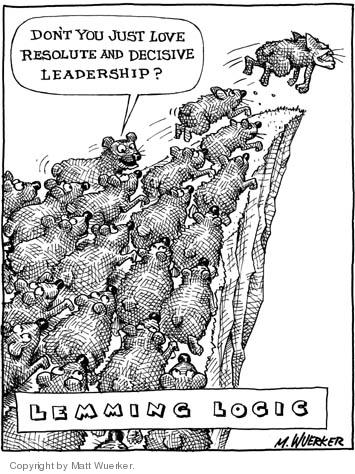
People like Frank Luntz and Walter Lippmann make this process seem ethical and even somewhat NECESSARY. In “The Disenchanted Man”, Lippmann empathizes With thE poor uneducated public. “No newspApeR rEports his environment so that he can grasp it; no school has taught him how to imagine it; his ideals, often, do NOT fit with it,” (37). Although this is true, and people cannot often see the direct relation to government and their own lives, this mentality reduces people to SHEEP. It basically says that the only responsibility anyone has is to cast a vote for whoever herds them in the “right” direction.


Take a look at the current presidential race. It began with nearly 20 people, possibly more. The clear front-runners were Hillary Clinton and Rudy Giuliani. In December Republican candidate Mike Huckabee went from being virtually unknown to a household name. Why? Because news networks like CNN and Fox News began to talk about him, therefore promote him. People who watch Fox News hear his name and associate him with their side. People who watch CNN hear his name and think he might be a threat. Either way, the option/threat of Mike Huckabee that was non-existent last summer, became An oveRnight nEws story. Suddenly he was winning delegates. But just as fast as the media pumped him up they brought him down, encouraging him to drop out of the race. Suddenly, he was losing votes.


My point is, when directions are already decided “for the good of the public”, THE PUBLIC LOSES ITS VOICE and must go in one direction or the other. “Before a mass of general opinions can eventuate in executive action, the choice is narrowed down to a few alternatives,” Lippmann states. “The victorious alternative is executed not by the mass but by individuals in control of its energy” (40). This practice has resulted in an election season that is nearly over, with front-runners that were chosen for us not by us, therefore defeating the point of democracy in the first place.
Lippmann claims that people are apathetic and do not truly care about what is going on in the world because it does not directly effect them (37). He later explains that there is not a man in the world who can know everything about every issue; therefore they should not be plagued with the responsibility of determining their own life. They do not have the means to do so (39). Because giving people information about their own world would be too daunting, people are kept in the dark and in a herd.
It is undeniable that there are people who simply do not care about the quality of the product they buy or the politician they vote for. For whatever reason, not everyone values “the bigger picture”. BUT to deny people the right to information is to deny them the right to think. In a perfect world for politics and consumerism, people would blindly believe what ISfed to them, questioning nothing, and believing that EVERYTHING is done in their best interest. But if all people acted this way, change would never come about. REVOLUTIONS would NEVER be fought, dictatorships would never END, and IN all likelihood the United States of America would not exist.

LOYALTY DESPITE THE FACTS IS BECAUSE THEY ARE UNINFORMED. SOMETIMES PEOPLE ARE OK WITH THAT. BUT IGNORANCE IS DANGEROUS WHENEVER POLITICIANS ARE FOR SALE. WHETHER A POLITICIAN IS BEST DOESN'T MATTER AS LONG AS THE VOTER BELIEVES THE POLITICIAN IS THE BEST CHOICE. DECISIONS BASED ON NARROWCASTING ARE NOT DECISIONS AT ALL. PUBLIC MANIPULATION IS NOT NECESSARY. WE ARE NOT SHEEP. PEOPLE WHO WATCH FOX NEWS AND PEOPLE WHO WATCH CNN ARE LOSING. THE PUBLIC LOSES ITS VOICE WITH FRONT-RUNNERS CHOSEN FOR US NOT BY US, DEFEATING DEMOCRACY. PEOPLE ARE APATHETIC. IT IS UNDENIABLE. BUT THE RIGHT TO INFORMATION IS EVERYTHING. REVOLUTIONS NEVER END IN THE UNITED STATES OF AMERICA.
Subscribe to:
Posts (Atom)